Wet Bulb Temperature Calculator
Enter the air temperature and humidity to get the wet-bulb temperature, or calculate WBGT from measured readings.
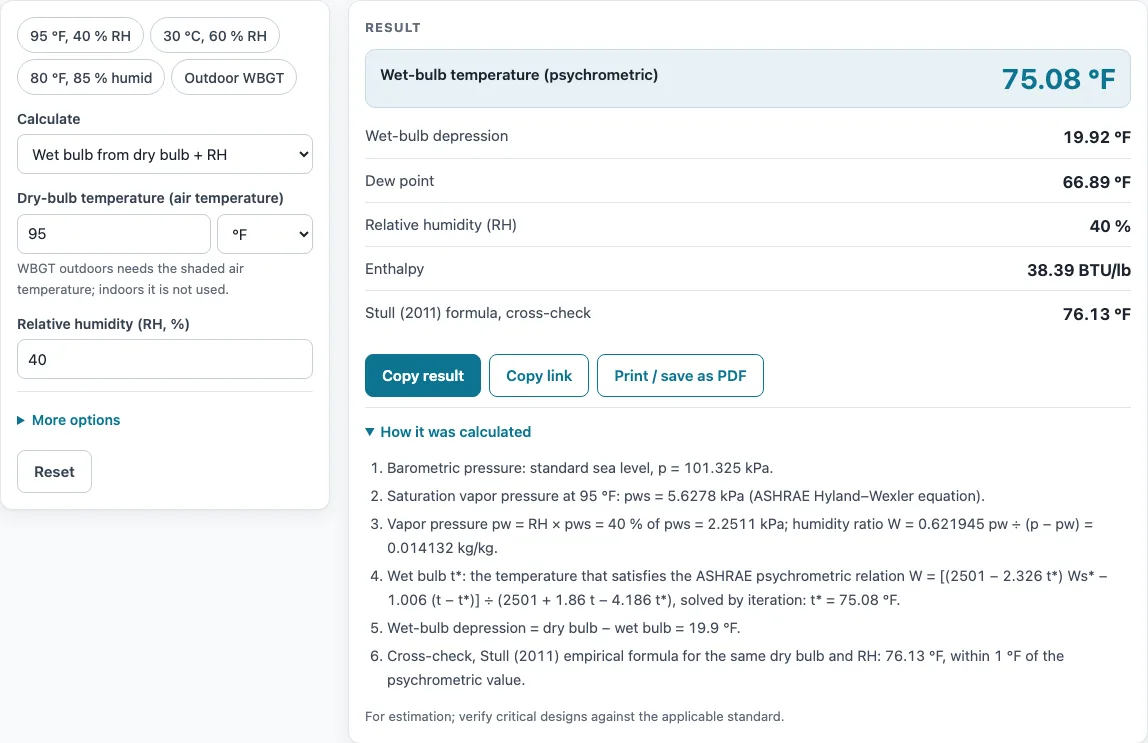
How to use the Wet Bulb Calculator
- Open the Calculate drop-down and choose a mode: Wet bulb from dry bulb + RH, Wet bulb from dry bulb + dew point, or WBGT heat-stress index (measured values).
- For WBGT only, open Where is the reading taken? and select Outdoors, with sun (solar load) or Indoors or outdoors without sun.
- Enter the Dry-bulb temperature (air temperature) and choose °F or °C. For outdoor WBGT, use the shaded air temperature.
- For dry bulb + RH, enter Relative humidity (RH, %). For dry bulb + dew point, enter Dew point and choose its unit.
- For WBGT, enter Natural wet-bulb temperature (Tnwb) and Globe temperature (Tg). Do not paste the psychrometric wet bulb into Tnwb.
- If the site is at height, open More options and enter Altitude above sea level in ft or m.
- Read the result rows shown for your mode, then check any warning and the “How it was calculated” steps.
Click an example button above the form, such as 95 °F, 40 % RH or Outdoor WBGT, to load a worked case. Reset returns the form to the starting example. Copy result gives you the result lines with a link, Copy link saves every input in the page address so the calculation reopens later, and Print / save as PDF produces a copy with the inputs, results, steps and date.
How do you calculate wet bulb temperature?
The calculator solves the ASHRAE psychrometric equation for the thermodynamic wet bulb at the pressure you give it. The physical idea is simple. Water evaporating into air takes heat from that air, so the air cools while it gains moisture. The wet-bulb temperature is where that exchange balances. You can see the same effect with a thermometer whose bulb is covered by a wet wick in moving air: the reading falls as water evaporates and settles at the wet bulb.
Dry air allows more evaporation, so the wet bulb sits further below the dry bulb. The difference is the wet-bulb depression, which equals dry bulb minus wet bulb. At 40 % RH, a dry bulb of 95 °F gives a wet bulb of 75.08 °F, a depression of about 20 °F. At 100 % RH, the depression is zero because the air cannot take up any more evaporation.
The Stull (2011) formula appears as a cross-check. It is only valid from about 5 to 99 % RH and from −20 to 50 °C. Outside that range, use the psychrometric wet bulb shown in the result.
What is the difference between wet bulb and dew point?
Dew point is the temperature at which air, with its current moisture content, would reach saturation if it were cooled at constant pressure. No water is evaporated to reach it, and the air’s moisture stays the same. Wet bulb is reached by evaporating water into the air, so moisture is added while the air cools.
Because of this, the wet bulb always sits between the dew point and the dry bulb. For example, a dry bulb of 86 °F with a dew point of 70 °F gives a wet bulb of 74.54 °F. The two temperatures meet only when the air is saturated, at 100 % RH.
Sources
Data and methods used by this calculator (checked October 2026):
- ASHRAE Handbook—Fundamentals 2017, ch. 1 Psychrometrics
- Stull (2011), wet-bulb temperature from relative humidity and air temperature
- OSHA Technical Manual, heat stress (WBGT weights)
Worked examples
| Input | Result |
|---|---|
| Dry bulb 95 °F, RH 40 % | Wet bulb 75.08 °F |
| Dry bulb 30 °C, RH 60 % | Wet bulb 23.81 °C |
| Dry bulb 80 °F, RH 85 % | Wet bulb 76.38 °F |
| Dry bulb 86 °F, dew point 70 °F | Wet bulb 74.54 °F |
| Natural wet bulb 78 °F, globe 120 °F, dry bulb 92 °F | WBGT 87.8 °F |
Calculated by the tool above with these values.
Frequently asked questions
How do you calculate WBGT?
Calculating WBGT needs three measured readings, combined as a weighted average. Outdoors in sun, it is 0.7 × Tnwb + 0.2 × Tg + 0.1 × Tdb. Indoors or without sun, it is 0.7 × Tnwb + 0.3 × Tg. The calculator’s WBGT mode applies these weights, so you only enter the readings. For example, Tnwb 78 °F, Tg 120 °F and dry bulb 92 °F give a WBGT of 87.8 °F.
Why does wet bulb temperature matter?
The wet bulb sets a limit on evaporative cooling. Evaporative coolers and cooling towers can only cool toward the wet-bulb temperature and cannot go below it. In heat-stress work, the natural wet bulb matters because evaporation from the skin is one way the body sheds heat, and WBGT is built on that reading.
Is the wet bulb the same as the natural wet-bulb temperature?
No. The psychrometric wet bulb is calculated from air conditions and pressure. The natural wet-bulb temperature is measured with a wick exposed to the open air and the sun’s effect. The calculator needs the natural value only in WBGT mode, so do not enter the psychrometric result there.
Can I convert dry bulb to wet bulb without RH?
Yes. Choose the dew point mode and enter the dew point with the dry bulb. For example, a dry bulb of 86 °F and a dew point of 70 °F give a wet bulb of 74.54 °F.
Why does altitude change the wet bulb?
Air pressure is lower at altitude, so the same RH gives a lower wet bulb than it would at sea level. Enter the altitude under More options to include this effect.
What do the calculator’s warnings mean?
If the Stull cross-check falls outside 5–99 % RH or −20 to 50 °C, use the psychrometric value instead. If the dew point is below 0 °C (32 °F), the figure is a frost point calculated over ice. If the natural wet bulb is higher than the dry bulb, or the globe temperature is lower than the natural wet bulb, check which reading you entered where.
Related tools
- Dew point calculator: Use it when you need the dew point on its own, without a wet-bulb result.
- Psychrometric calculator: Use it when you need the full set of air properties, such as enthalpy and humidity ratio, together.
- Superheat calculator: Use it when you are checking refrigerant superheat in a cooling system.
- CFM calculator: Use it when you need airflow in cubic feet per minute for a space or duct.
- Chiller tonnage calculator: Use it when you are sizing chiller capacity for a cooling load.
- All HVAC calculators: Use it to browse every calculator on the site.