SEER Savings Calculator
Enter the size and the old and new SEER or SEER2 ratings to see the electricity and money saved on cooling each year.
The SEER Savings Calculator compares the yearly cooling electricity of your current air conditioner or heat pump with a new, more efficient one. You enter the cooling capacity, the old and new SEER or SEER2 ratings, how many full-load hours the system runs in a year and what you pay per kWh. The tool shows the kWh and money saved, the percentage saved and, if you type an installed cost, a simple payback.
It uses the definition of SEER itself: cooling delivered over a season in BTU divided by the electricity used in watt-hours. That keeps the maths transparent, and every step is shown. The calculator runs in your browser, is free, needs no sign-up and uploads nothing. The result is an estimate for cooling only; the real saving depends on your climate, ducts, thermostat habits and how the system is installed.
How to use the SEER Savings Calculator
- Start with an example button above the form, or enter your own values.
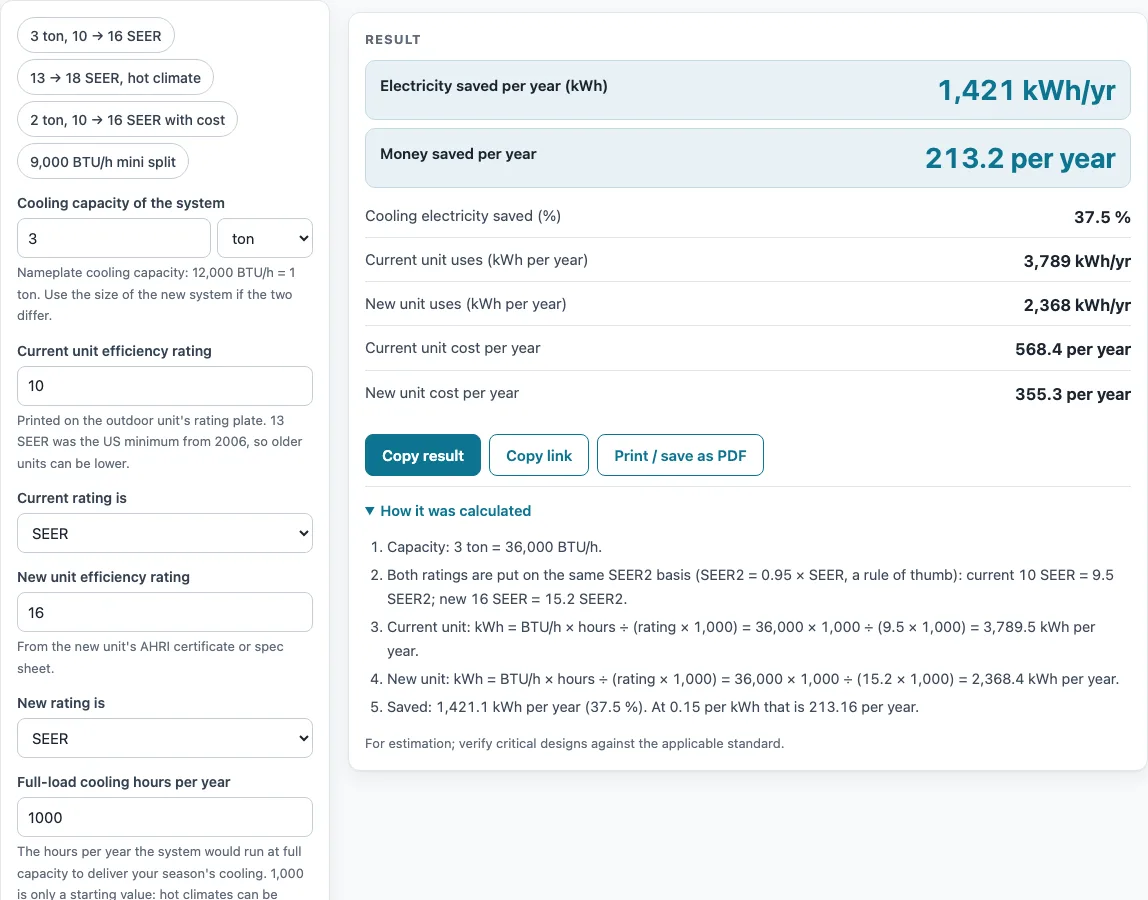
- Enter the Cooling capacity of the system in tons, BTU/h or kW. One ton is 12,000 BTU/h. It is on the outdoor unit’s rating plate.
- Enter the Current unit efficiency rating and say whether it is SEER or SEER2. The old rating is on the rating plate; if it is missing, look up the model number.
- Enter the New unit efficiency rating and choose SEER or SEER2. Use the AHRI certificate or spec sheet of the unit you are considering.
- Enter the Full-load cooling hours per year: the number of hours the system would run at full capacity to deliver your cooling season. The starting value of 1,000 is only an example; hot climates are higher and mild ones lower.
- Enter the Electricity price per kWh from your bill, in your own currency.
- Optional: under More options, enter the Installed cost of the new system to get a simple payback, and the number of years to count.
- Read the savings, then open How it was calculated to see each step with your numbers.
Copy result copies the result lines and a link. Copy link saves every input in the page address. Print / save as PDF prints your inputs, results, steps and the date. Reset restores the starting example.
How much will a higher SEER rating save?
SEER (seasonal energy efficiency ratio) is the cooling a system delivers over a season, in BTU, divided by the electricity it uses, in watt-hours. So the electricity used is the cooling delivered divided by the SEER. For a 3-ton (36,000 BTU/h) system running 1,000 full-load hours a year, the cooling delivered is 36,000,000 BTU. At 10 SEER (9.5 on the SEER2 scale) that takes about 3,789 kWh; at 16 SEER (15.2 SEER2) it takes about 2,368 kWh. The saving is about 1,421 kWh a year, or 37.5 %, which is worth 213 a year at 0.15 per kWh.
The percentage saved depends only on the two ratings: it is 1 − old ÷ new. Going from 13 to 20 SEER saves 35 % of the cooling electricity whatever the size of the system. The size, the hours and the price only change the amount.
What is the difference between SEER and SEER2?
SEER2 is the same idea measured with a newer test. Since January 2023 the US test for central air conditioners and heat pumps uses a higher external static pressure (0.5 inches of water instead of 0.1) to resemble real ducts, so the same equipment gets a lower number. A common rule of thumb is SEER2 ≈ 0.95 × SEER, and the calculator uses it when you mix the two. The exact ratio differs slightly by source and equipment, so use the rating on the AHRI certificate when you can.
How accurate is the full-load hours number?
It is the least certain input. Full-load hours are the yearly cooling energy divided by the system’s capacity, not the hours the compressor is on. A system that runs part-load most of the time can have fewer full-load hours than its run-time suggests. Take the figure from a past energy audit or a utility report if you have one, or try a range such as 800, 1,200 and 1,600 to see how the saving scales. It scales in direct proportion.
Sources
Data and methods used by this calculator (checked October 2026):
Worked examples
| Input | Result |
|---|---|
| 3 ton, 10 SEER → 16 SEER, 1000 full-load hours, 0.15 per kWh | 1,421 kWh saved per year (37.5 %), 213.2 per year |
| 3 ton, 13 SEER → 18 SEER, 1500 full-load hours, 0.18 per kWh | 1,215 kWh saved per year (27.8 %), 218.6 per year |
| 2 ton, 10 SEER → 16 SEER, 1500 full-load hours, 0.18 per kWh | 1,421 kWh saved per year (37.5 %), 255.8 per year |
| 3 ton, 14 SEER → 15.2 SEER2, 1000 full-load hours, 0.15 per kWh | 338.3 kWh saved per year (12.5 %), 50.75 per year |
| 9000 BTU/h, 9 SEER → 22 SEER, 800 full-load hours, 0.25 per kWh | 497.6 kWh saved per year (59.1 %), 124.4 per year |
Calculated by the tool above with these values.
Frequently asked questions
Is a higher SEER worth it?
It is worth it when the old unit is inefficient, the system runs many hours and electricity is expensive. Upgrading a 10 SEER unit to 16 SEER cuts cooling electricity by 37.5 %. Upgrading from 16 to 18 SEER saves about 11 %. Enter an installed cost under More options to see the payback for your case, and remember that a new system also brings comfort, reliability and refrigerant changes that the calculator does not price.
How many kWh does a 3-ton air conditioner use per year?
With the starting values (1,000 full-load hours) a 3-ton unit uses about 3,789 kWh a year at 10 SEER and about 2,368 kWh at 16 SEER. At 1,500 hours these numbers are 1.5 times higher. Your own figure depends on your climate and house.
Does SEER apply to heating?
No. SEER measures cooling. The heating efficiency of a heat pump is rated separately (HSPF or HSPF2), so this calculator covers only the cooling side of a heat pump.
What is a good SEER rating?
A minimum of 13 SEER took effect in the US in January 2006, and the 2023 test change set new SEER2 minimums that depend on region and size. A higher number means less electricity for the same cooling. Compare the rating with the price, the climate and the savings the calculator shows.
Can I use the results in a quote or report?
Yes. Results, charts and printouts can be used freely in commercial work such as quotes, proposals, reports and service records, and no attribution is needed. For estimation; verify critical designs against the applicable standard.
Related tools
- AC size calculator to check what cooling capacity the new system needs.
- Heat pump size calculator for the heating side of a heat pump.
- BTU calculator for a quick cooling or heating load.
- BTU to kW converter to convert the capacity between units.
- Mini split BTU calculator for a single-room system.
- All HVAC calculators to browse every calculator on the site.