Radiator BTU Calculator
Enter the room size, walls and windows to get the heat output a radiator must give, in BTU/h and watts, corrected for your water temperature.
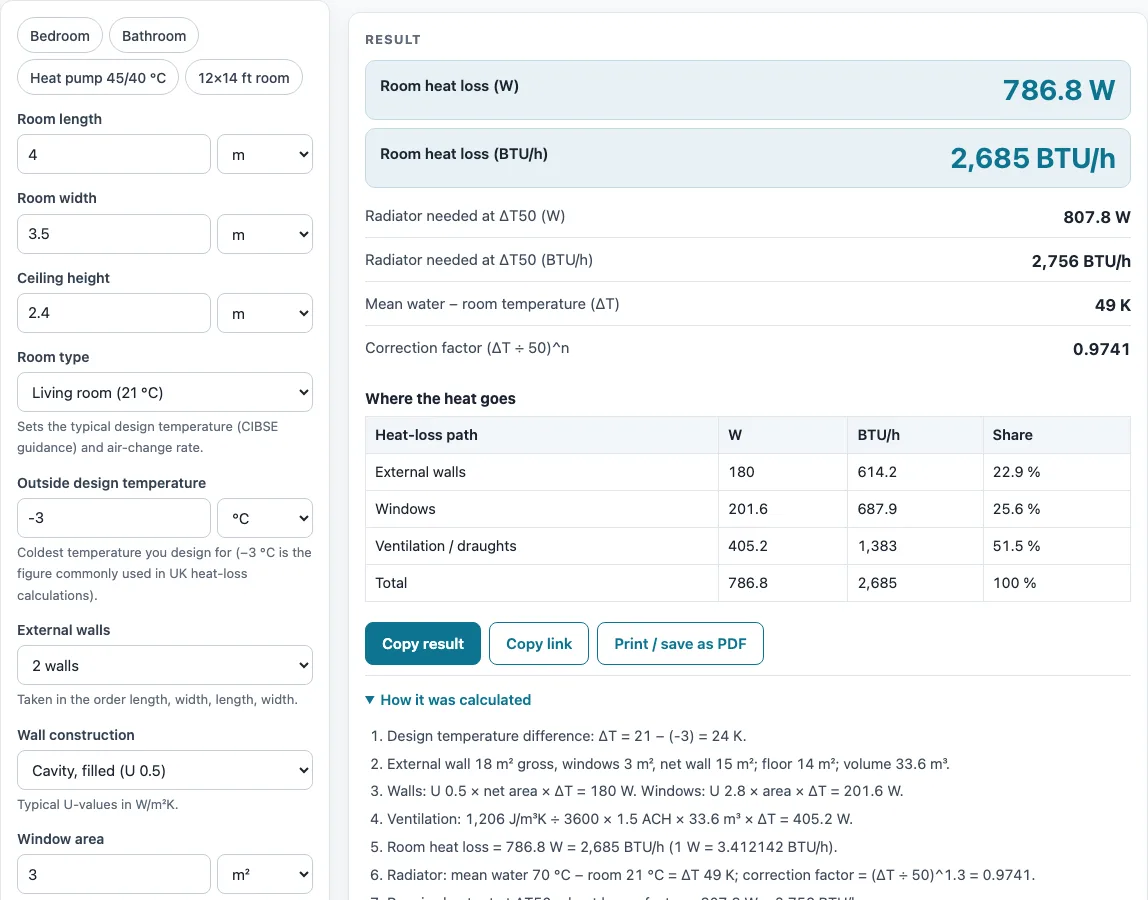
How to use the radiator BTU calculator
- Choose an example button above the form (Bedroom, Bathroom, Heat pump 45/40 °C or 12×14 ft room), or start from the default example.
- Enter the Room length, Room width and Ceiling height. Choose m or ft for each.
- Select the Room type. This sets the design temperature and air-change rate.
- Enter the Outside design temperature for your location (MCS and CIBSE publish design temperatures); −3 °C is only the example value.
- Select the number of External walls and the Wall construction.
- Enter the Window area and select the Glazing.
- Tick Room above is unheated or a loft and/or Ground floor if they apply.
- Open More options if you need to change the room temperature, air changes, Flow temperature, Return temperature or Radiator exponent (n). Use 45/40 °C for a heat pump and 75/65 °C for a traditional boiler system.
- Read the results: Room heat loss (W and BTU/h), Radiator needed at ΔT50 (W and BTU/h), and the Correction factor. Check any warnings below them.
Use Copy result to copy the result lines with a link, or Copy link to save the exact inputs in the page address. Print / save as PDF includes the inputs, results, steps and date. Reset restores the starting example.
How do I work out what size radiator I need?
A radiator must give out as much heat as the room loses at the coldest outside temperature you design for. Heat loss is the sum of U × area × ΔT for each external wall, window, floor and ceiling, plus the heat needed to warm air that enters through ventilation.
ΔT here is the gap between the room design temperature and the outside design temperature. The calculator uses the CIBSE Domestic Heating Design Guide (2026) room temperatures for older homes: 21 °C for a living room, 18 °C for a bedroom, kitchen or hall and 22 °C for a bathroom. For air leakage it uses the guide’s minimum of 0.5 air changes per hour for every room; enter a higher rate for a draughty older room.
U-values describe how well each element insulates. The wall and window choices use the RdSAP 10 default values for England, for example 1.7 for solid brick 200–280 mm thick, 0.7 for a filled cavity and 2.8 for double glazing fitted before 2002. Pick the option closest to the actual room.
Once you have the heat loss, pick a radiator whose rating at ΔT50 is at least that figure, adjusted for the water temperature you run. The calculator shows this adjusted figure as Radiator needed at ΔT50.
What is delta T 50 on a radiator?
ΔT50 is the standard test condition for radiator ratings: water at 75 °C flow and 65 °C return, a mean of 70 °C, in a room at 20 °C, a difference of 50 K. Catalogue outputs are quoted at this point under the EN 442 test method.
Radiators give less heat at lower water temperatures. The output at your conditions is:
output = rated output × (ΔT ÷ 50)^n
Here ΔT is the mean water temperature minus the room temperature, and n is usually 1.3 for panel radiators. For example, at a mean water temperature of 45 °C in a 21 °C room, ΔT is 24, so the radiator gives (24 ÷ 50)^1.3 ≈ 39% of its ΔT50 rating.
This is why heat pump systems need larger radiators. The 4 × 3.5 m living room with two external walls loses 588.7 W and needs a radiator rated 604.3 W at ΔT50 with 75/65 °C water, but 1,763 W at ΔT50 with 45/40 °C water. If the mean water is only a few kelvin above the room, the calculator shows a warning.
Sources
Data and methods used by this calculator (checked October 2026):
- BRE, RdSAP 10 specification (June 2025): default wall, window and roof U-values
- MCS heat load calculator: design room temperatures (CIBSE DHDG 2026 Table 2-2)
- MCS heat load calculator: ventilation rates (CIBSE DHDG 2026 Table 2-18)
- Trystan Lea, radiator output at lower flow temperatures (ΔT correction, n ≈ 1.3)
Worked examples
| Input | Result |
|---|---|
| 4 × 3.5 × 2.4 m, Living room (21 °C), 2 external wall(s), water 75/65 °C | 588.7 W heat loss (2,009 BTU/h); radiator 604.3 W at ΔT50 |
| 3.5 × 3 × 2.4 m, Bedroom (18 °C), 1 external wall(s), water 75/65 °C | 278.3 W heat loss (949.5 BTU/h); radiator 264.4 W at ΔT50 |
| 2.5 × 2 × 2.4 m, Bathroom (22 °C), 1 external wall(s), water 75/65 °C | 291.5 W heat loss (994.6 BTU/h); radiator 307.4 W at ΔT50 |
| 4 × 3.5 × 2.4 m, Living room (21 °C), 2 external wall(s), water 45/40 °C | 579.1 W heat loss (1,976 BTU/h); radiator 1,735 W at ΔT50 |
| 14 × 12 × 8 ft, Living room (21 °C), 2 external wall(s), water 75/65 °C | 568.2 W heat loss (1,939 BTU/h); radiator 583.3 W at ΔT50 |
Calculated by the tool above with these values.
Frequently asked questions
How many BTU per cubic metre for a radiator?
There is no fixed BTU-per-cubic-metre figure that suits every room. Heat loss depends on the areas of walls, windows and floors and how well each one insulates. Two rooms of the same volume can need very different outputs.
What size radiator do I need for a heat pump?
Heat pumps usually run at lower water temperatures, so the radiator must be larger. Set the flow and return to 45/40 °C in the calculator. In the Heat pump 45/40 °C example, a living room losing 588.7 W needs a radiator rated 1,763 W at ΔT50, about three times its heat loss.
How many watts is a BTU?
A BTU is a unit of energy, while BTU/h is a unit of power, which is what radiator outputs use. One watt equals 3.412 BTU/h, so 1 BTU/h is about 0.293 W. The calculator shows both units.
What does the radiator calculator kW figure mean?
The calculator reports outputs in watts. One kW equals 1,000 W, so divide the watt figure by 1,000 to get kW.
Is the result accurate enough to order a radiator?
The result is for estimation. Verify critical designs against the applicable standard before you order.
Can I use the results on a quote or report?
Yes. Results, including printouts, may be used freely in commercial work such as quotes, proposals, reports and service records. No attribution is needed.
Related tools
- Boiler size calculator: use it to check the boiler output needed for your heating system.
- BTU calculator: use it for general BTU sizing when you are not working from a radiator.
- Furnace size calculator: use it to size a furnace for a space.
- BTU to kW converter: use it to convert BTU/h figures to kW quickly.
- Dew point calculator: use it to find the temperature at which condensation forms on surfaces.
- All HVAC calculators: use it to browse every calculator on the site.