R22 PT Chart (R-22 Pressure Temperature)
Look up the R-22 saturation pressure for a temperature, or the temperature for a gauge reading, and print the full chart.
This R22 PT chart lists the saturation pressure of R-22 at every temperature, with a lookup in both directions. This free R-22 PT chart calculator converts between temperature and pressure for R-22 (HCFC-22), in either direction. Enter a temperature to get the saturation pressure, or enter a pressure to get the saturation temperature. The tool also builds a full pressure-temperature table, so you can read a range of values at once. Results appear in °F with psig, or in °C with bar or kPa (gauge).
The calculator runs in your browser. Nothing is uploaded, there is no sign-up, and it is free to use. R-22 was the common refrigerant for US residential air conditioning before R-410A, so the chart is most useful for older systems. Treat the results as estimates, and use the equipment manufacturer’s chart and charging instructions when they are available.
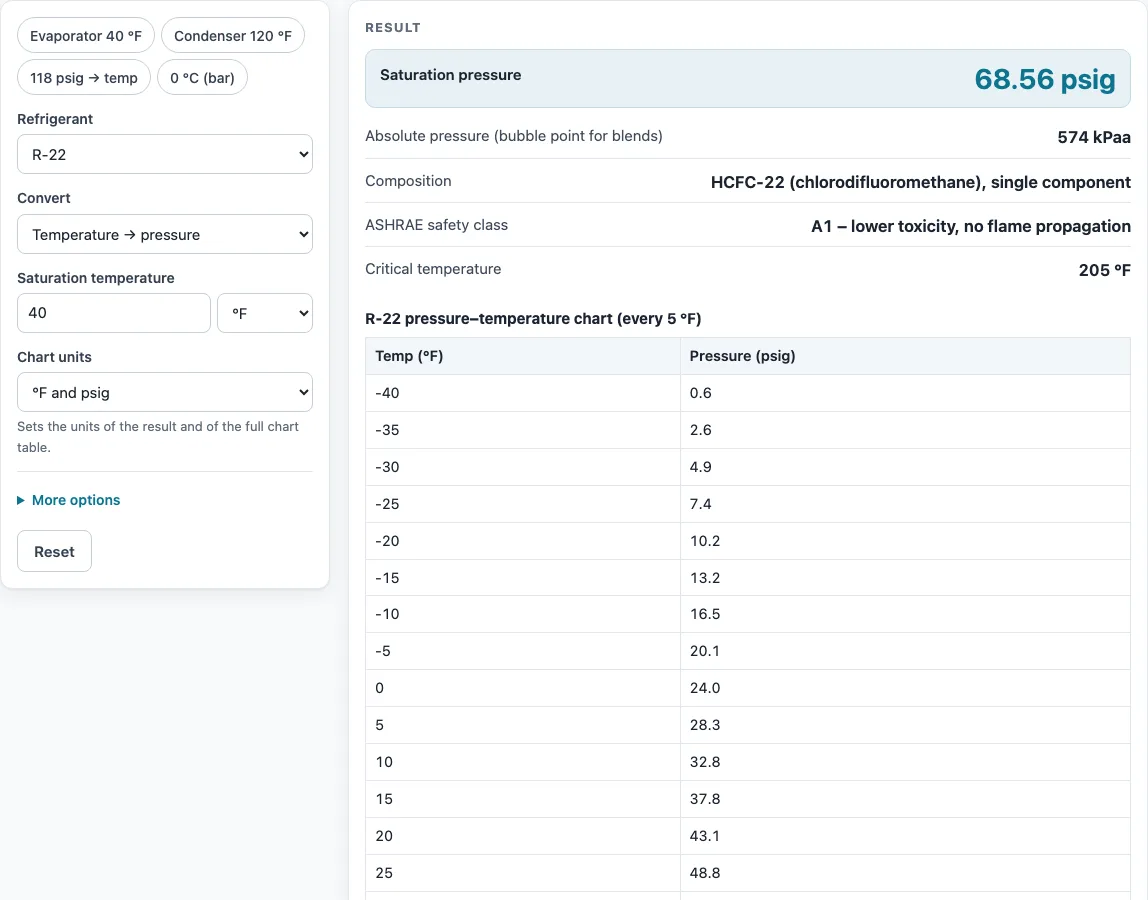
How to use the R-22 PT chart calculator
- Set Refrigerant to R-22. Check this first, because the page opens with a different example.
- Set Convert to “Temperature → pressure” to find the pressure at a known temperature, or to “Pressure → temperature” to find the temperature at a known pressure.
- Enter your value in Saturation temperature or in the pressure field. Some modes do not show every input.
- If you entered a pressure, pick the unit in Gauge or absolute pressure. Use psig, kPag or barg for a gauge reading, or psia, kPaa or bara for absolute pressure.
- Choose Chart units: °F and psig, °C and bar (gauge), or °C and kPa (gauge). This sets the units of the result and of the chart table.
- Open More options to set Chart table step (Auto, every 1, 2, 5 or 10 degrees). If you are above sea level, enter Altitude above sea level. Leave it blank at sea level.
- Read the result rows and the pressure-temperature table below the result. Open “How it was calculated” to see each step with your numbers.
The example buttons above the form load sample calculations, such as “R-22 100 psig → temp”. Reset restores the starting example.
Copy result copies the result lines with a link. Copy link saves every input in the page address, so the same calculation reopens later. Print / save as PDF produces a record with your inputs, results, steps and the date.
How do you read a PT chart?
Find the temperature in the temperature column, then read across to the pressure beside it. That pressure is the saturation pressure, the point at which R-22 boils or condenses at that temperature. For R-22 at 70 °F, the chart gives 121.4 psig at sea level.
The chart temperature is the real refrigerant temperature only where liquid and vapor are both present, such as in the evaporator or condenser. In a superheated suction line or a subcooled liquid line the pressure is still about the evaporator or condenser pressure, but the pipe temperature is not the chart temperature: the difference between the two is the superheat or the subcooling. The chart is a reference for the coil temperature, not for every point in the system.
The table also works in reverse. If a gauge reads 68 psig on R-22, the saturation temperature is about 39.61 °F. Use the “Pressure → temperature” mode to get an exact value for any reading.
Is a PT chart in psig or psia?
A PT chart for service work is in psig, which is gauge pressure: the reading above local atmospheric pressure. Gauges show psig, so at sea level the chart matches your gauge directly. psia is absolute pressure, measured from a perfect vacuum. It equals psig + 14.696 at sea level.
Altitude changes the gauge reading. Local air pressure falls as you go up, so a gauge reads differently at altitude even when the refrigerant is the same. Enter the altitude under More options and the calculator accounts for it. For metric units, choose bar (gauge) or kPa (gauge) under Chart units. For example, 0 °C corresponds to 3.967 barg.
How the R-22 values are calculated
The chart is not typed in from a printed table. It comes from the published equation of state for R-22, evaluated at every whole degree Celsius, and the calculator interpolates between those points (pressure is close to a straight line on a log scale against 1/temperature, so the error is far below gauge resolution). Checked against NIST data, the values agree within 0.01 %. A few points from the chart at sea level: -20 °F: 10.2 psig; 0 °F: 24.0 psig; 20 °F: 43.1 psig; 40 °F: 68.6 psig; 70 °F: 121.4 psig; 100 °F: 195.9 psig; 120 °F: 260.0 psig.. Set your altitude under More options and the gauge values shift by the difference in atmospheric pressure.
Sources
Data and methods used by this calculator (checked October 2026):
- CoolProp equations of state (saturation data)
- NIST Chemistry WebBook, thermophysical properties of fluids (pure refrigerants, checked within 0.05 %)
- Goodman, A1 vs. A2L pressure temperature chart, USA °F/psig (R-22, R-410A, R-32, R-454B)
- ASHRAE Standard 34 refrigerant designations and safety classes
Worked examples
| Input | Result |
|---|---|
| R-22, 40 °F | 68.56 psig |
| R-22, 120 °F | 260 psig |
| R-22, 68 psig | 39.61 °F |
| R-22, 0 °C | 3.967 barg |
Calculated by the tool above with these values.
Frequently asked questions
What is the pressure of R-22 at 70 °F (standing pressure)?
At sea level, R-22 at 70 °F has a saturation pressure of 121.4 psig. Standing pressure is the reading on a system that has been off long enough for the refrigerant to reach the surrounding air temperature, so both sides read the same value.
What should R-22 pressures be when running?
There is no single correct pair of numbers, because running pressures depend on outdoor and indoor temperatures, the load and the equipment. Convert the evaporator and condenser temperatures you measure into pressures with this chart, then compare them with the manufacturer’s charging instructions.
Is R-22 still available for service?
US production and import ended on January 1, 2020, under the EPA phase-out. Only recovered, reclaimed or stockpiled R-22 can service existing systems. R-22 is also an ozone-depleting HCFC, so handle it according to the rules that apply where you work.
Is R-22 a blend?
No. R-22 (HCFC-22, chlorodifluoromethane) is a single-component refrigerant. Each temperature has exactly one saturation pressure, so there is no temperature glide to account for, unlike with zeotropic blends.
What is the safety class of R-22?
R-22 is ASHRAE safety class A1, which means it has low toxicity and does not propagate flame. Its critical temperature is about 205 °F (96.1 °C), which is well above normal service temperatures.
Can I use this chart for R-410A?
No. Switch the Refrigerant setting to R-410A on the calculator, or use the R-410A chart page. Each refrigerant has its own pressure-temperature relationship, so an R-22 chart gives wrong values for R-410A.
Related tools
- All refrigerant PT charts: Use this to compare pressure-temperature data across several refrigerants.
- Superheat and subcooling calculator: Use this to turn your pressure and temperature readings into superheat and subcooling values.
- R-410A PT chart: Use this when the system uses R-410A instead of R-22.
- R-32 PT chart: Use this for systems charged with R-32.
- R-454B PT chart: Use this for systems charged with R-454B.
- R-134a PT chart: Use this for systems charged with R-134a.
- R-404A PT chart: Use this for systems charged with R-404A.
- All HVAC calculators: Use this to find other calculators for heating and cooling work.