Mini Split BTU Calculator
Enter each room you want to cool to get its BTU, the head size for each zone and the outdoor unit size.
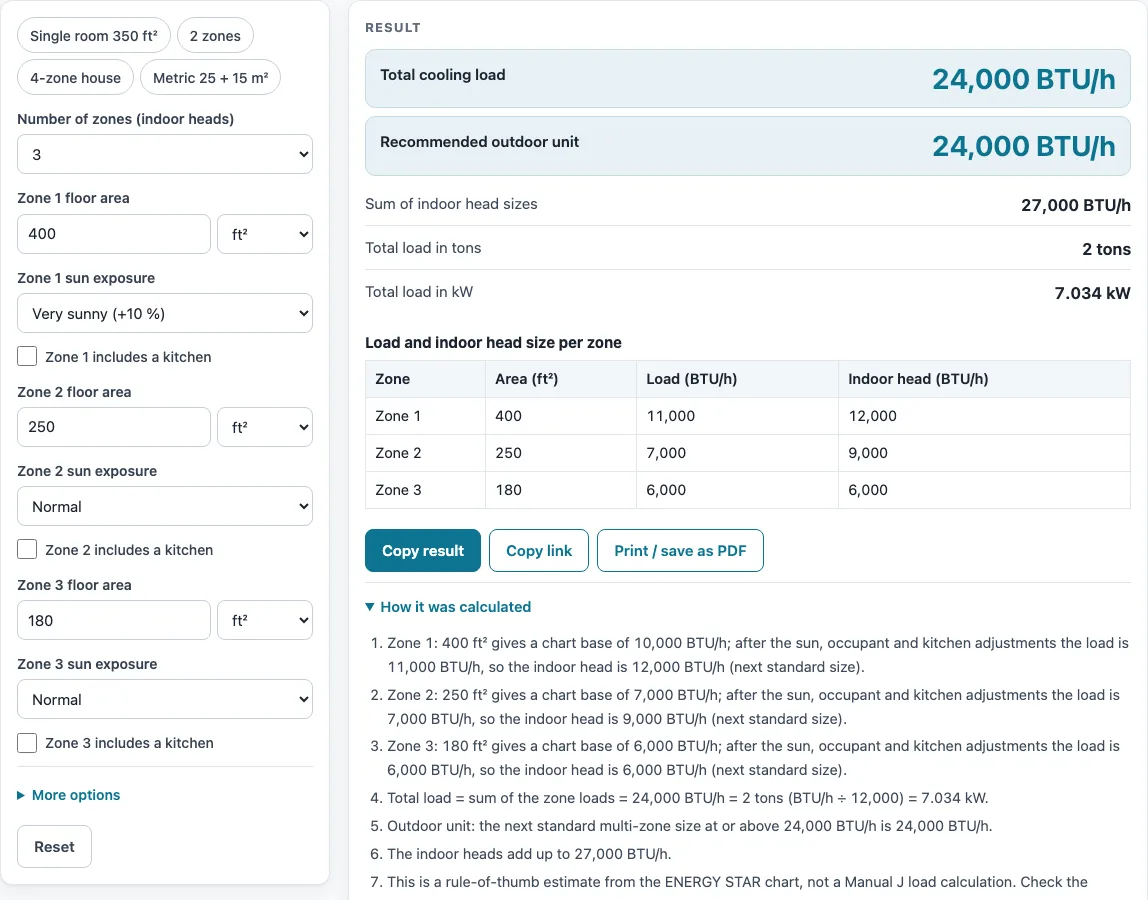
How to use the Mini Split BTU Calculator
- Open the calculator at the top of this page. To try a ready-made case first, click one of the example buttons: Single room 350 ft², 2 zones, 4-zone house, or Metric 25 + 15 m².
- Choose your number of indoor heads in the “Number of zones (indoor heads)” drop-down. The options run from 1 to 5.
- Enter the floor area for each zone, pick its sun exposure and tick the kitchen box if that zone includes a kitchen. Each zone is one room served by one indoor head.
- Open “More options” and set “Regular occupants per zone.” The help text says each person beyond two adds 600 BTU/h in every zone.
- Read the results. Only the rows that apply to your chosen mode appear, such as Total cooling load, Recommended outdoor unit, Sum of indoor head sizes, Total load in tons, and Total load in kW.
- Check the table “Load and indoor head size per zone,” then read any warning shown under the result.
- Open “How it was calculated” to see the formula and each step using your numbers.
Use Copy result to copy the result lines with a link, or Copy link to save the exact inputs in the page address. Print / save as PDF produces a copy with inputs, results, steps, and the date. Reset returns the form to the starting example.
What size mini split do I need?
Each room needs its own indoor head, and the calculator sizes each room separately. It uses the ENERGY STAR room chart, applies its adjustments to your floor area, and rounds the result up to the next standard head size. Common sizes are 6,000, 9,000, 12,000, 15,000, 18,000, and 24,000 BTU/h, with larger sizes available.
Rounding up is deliberate. If a room needs 10,000 BTU/h of cooling, the next available head is 12,000 BTU/h. For example, a 350 ft² single room gets a 9,000 BTU/h head. Floor areas under 100 ft² fall below the chart, so the calculator uses the smallest chart capacity of 5,000 BTU/h. Areas above 2,500 ft² go beyond the chart, and the result is extrapolated. For those spaces, a Manual J load calculation is the better basis.
A mini split also heats. Its heating capacity at your winter design temperature is lower than its rated capacity, so in cold climates confirm that number before you buy.
Can one outdoor unit run several mini split heads?
Yes. A multi-zone outdoor unit serves several indoor heads, and the calculator sizes that unit for the total load of all zones. Multi-zone outdoor units come in sizes such as 18,000 to 48,000 BTU/h. Each zone’s load is added together to produce the total load, and the recommended outdoor unit is sized for that total.
The indoor heads can add up to more than the outdoor unit’s rating. In the three-zone example, the heads total 27,000 BTU/h on a 24,000 BTU/h outdoor unit. Many multi-zone units accept this, but only within the limits in the manufacturer’s combination table. The calculator shows a warning when the heads add up to more than 130 % of the outdoor unit, but check that table before you buy in any case.
Sources
Data and methods used by this calculator (checked October 2026):
- ENERGY STAR, room air conditioner sizing chart and adjustments
- Fujitsu multi-zone brochure (indoor capacity up to 130 % of the outdoor unit)
Worked examples
| Input | Result |
|---|---|
| 3 zone(s): 400 ft² + 250 ft² + 180 ft² | load 24,000 BTU/h, outdoor 24,000 BTU/h, heads 12,000 + 9,000 + 6,000 |
| 1 zone(s): 350 ft² | load 9,000 BTU/h, outdoor 9,000 BTU/h, heads 9,000 |
| 2 zone(s): 300 ft² + 300 ft² | load 16,000 BTU/h, outdoor 18,000 BTU/h, heads 9,000 + 9,000 |
| 4 zone(s): 450 ft² + 300 ft² + 250 ft² + 200 ft² | load 33,000 BTU/h, outdoor 36,000 BTU/h, heads 12,000 + 9,000 + 9,000 + 6,000 |
| 2 zone(s): 25 m² + 15 m² | load 13,000 BTU/h, outdoor 18,000 BTU/h, heads 9,000 + 6,000 |
Calculated by the tool above with these values.
Frequently asked questions
How many BTU mini split for 500 square feet?
With normal sun, two occupants and no kitchen, 500 ft² falls in the 450–550 ft² chart band: 12,000 BTU/h, so a 12,000 BTU/h head. A very sunny room adds 10 % (13,200 BTU/h), which moves it to a 15,000 BTU/h head.
Is it OK to oversize a mini split?
Oversizing is generally a poor choice. An oversized unit cools the room quickly, shuts off before it has run long enough to remove humidity, and cycles on and off often. The calculator rounds up to the next head size, so check whether that step already gives you enough capacity.
Does the calculator count people in the room?
Yes. Set “Regular occupants per zone” under “More options.” Each person beyond two adds 600 BTU/h in every zone, according to the help text.
Does a mini split heat as well as cool?
Yes, a mini split heat pump heats. The calculator sizes for cooling, so for cold climates check the unit’s heating capacity at your winter design temperature, which is lower than its rated capacity.
Can I use the results in a quote or report?
Yes. Results, charts, and printouts may be used freely in commercial work such as quotes, proposals, reports, and service records, with no attribution needed. Every result carries the note “For estimation; verify critical designs against the applicable standard.”
Related tools
- BTU calculator: Use it for general cooling load estimates when you are not working with a mini split.
- AC size calculator: Use it to compare sizing for a conventional central or window air conditioner.
- BTU to kW converter: Use it to convert the BTU/h figures in your results into kilowatts.
- Superheat calculator: Use it to check refrigerant superheat once a system is installed and running.
- R-410A PT chart: Use it to look up pressure and temperature values for R-410A refrigerant.
- R-32 PT chart: Use it to look up pressure and temperature values for R-32 refrigerant.
- All HVAC calculators: Use it to browse every calculator on the site.