Heat Pump Size Calculator
Enter your home's size, insulation and winter design temperature to get the heat pump size in tons, with the cold-weather capacity loss taken into account.
The Heat Pump Size Calculator estimates how many tons of heat pump a home needs for heating. It first works out the home’s design heat loss from its floor area, stories, ceiling height, windows, insulation and the coldest normal outdoor temperature. It then picks the common nominal size, in half-ton steps, whose capacity at that outdoor temperature still covers the loss, and shows how much backup heat would be left over. That last step is what separates heat pump sizing from furnace sizing, because a heat pump delivers less heat as the outside air gets colder.
The tool runs in your browser, is free, needs no sign-up and uploads nothing. It works as a heat pump size estimator for ducted and ductless (mini split) systems that heat with air. Results are planning estimates to compare with an installer’s load calculation, not a replacement for one.
How to use the Heat Pump Size Calculator
- Start with an example button above the form, or enter your own values.
- Enter the Heated floor area (all stories) in ft² or m², the Number of stories and the Ceiling height.
- Enter Windows (% of exterior wall area). Typical homes are about 10–20 %.
- Choose the Insulation level: the IECC 2018 code level (climate zone 5) or Custom. Custom shows the wall, ceiling and floor R-values, the window U-factor and the air changes per hour under More options.
- Enter the Indoor temperature and the Outdoor design temperature, which is your local 99 % winter heating design temperature.
- Enter the Heat pump capacity at the design temperature (% of nominal). Take it from the manufacturer’s performance table for the model you are considering: heating capacity at your design temperature divided by the nominal (rated) capacity. If you do not know the model yet, read the table at the bottom of the results, which shows the size for 100, 80, 60 and 50 %.
- Optional: under More options, type a Design cooling load so the size also covers summer.
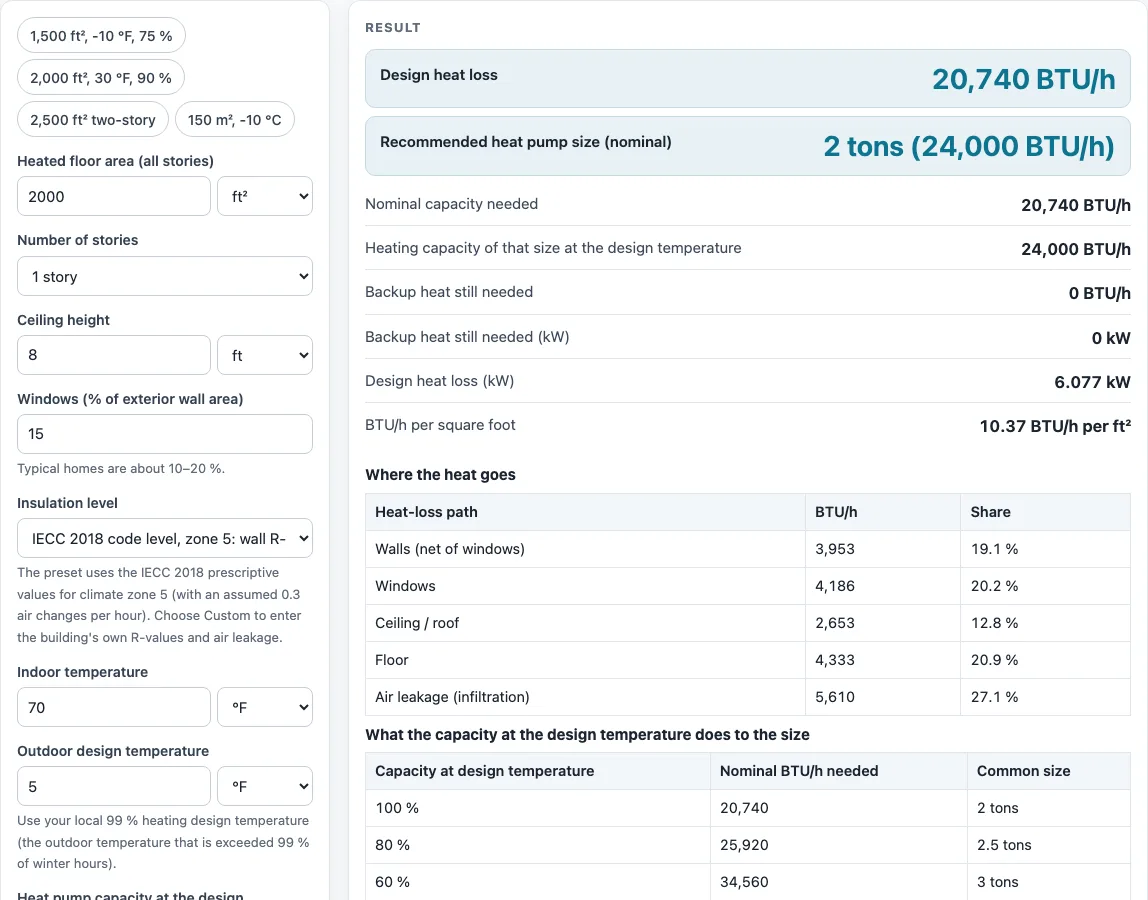
- Read the design heat loss, the recommended size in tons, the heating capacity of that size at the design temperature and any backup heat still needed. Open How it was calculated to see each step with your numbers.
Copy result copies the result lines and a link. Copy link saves every input in the page address. Print / save as PDF prints your inputs, results, steps and the date. Reset restores the starting example.
How do I determine what size heat pump I need?
Determining heat pump size starts with the heat loss, not the square footage. The calculator adds up heat lost through the walls, windows, ceiling and floor (each U × area × temperature difference) and through air leakage. The temperature difference is the indoor temperature minus your outdoor design temperature, the temperature that is exceeded 99 % of winter hours. This is the same heat-loss method used by the furnace and boiler calculators on this site.
Then account for the cold. A heat pump’s rated capacity is quoted at a mild outdoor temperature, and its heating output falls as the temperature drops. If a unit delivers 80 % of its nominal capacity at your design temperature, the nominal size has to be the load divided by 0.8. For the 2,000 ft² IECC 2018 climate zone 5 example (70 °F indoors, 5 °F outdoors) the heat loss is 20,740 BTU/h. At 100 % that fits a 2-ton unit (24,000 BTU/h); at 70 % it needs 29,630 BTU/h nominal, which is a 2.5-ton unit (30,000 BTU/h). The scenario table under the results shows this for 100, 80, 60 and 50 %.
What happens when the heat pump cannot cover the whole load?
On the coldest days the shortfall is made up by backup heat, usually electric resistance strips, a furnace or a boiler. The calculator shows the backup heat left for the size it recommends, in BTU/h and kW. A shortfall of zero means the unit covers the design load by itself. If you pick a smaller unit to save money or to avoid oversizing in summer, the backup runs more often on cold days and the electricity bill goes up, because resistance heat is far less efficient than the heat pump.
Why not size by square footage alone?
A square-foot rule gives one number for a draughty 1950s house and a tight new one alike, although their heat loss can differ by a factor of two or more. Climate matters even more: the same house needs a larger nominal unit where the design temperature is −10 °F than where it is 30 °F, because the unit loses more capacity in the cold. Use the insulation level and the design temperature that match your building.
Sources
Data and methods used by this calculator (checked October 2026):
- An introduction to ACCA Manual S (equipment sizing against the design load)
- IECC 2018 prescriptive insulation and fenestration values (climate zone 5), state summary
- ASHRAE Handbook—Fundamentals 2017, ch. 1 Psychrometrics
Worked examples
| Input | Result |
|---|---|
| 2000 ft², 1-story, insulation: IECC 2018 code level, zone 5: wall R-20, ceiling R-49, floor R-30, windows U-0.30 (0.3 ACH assumed), 70 °F in, 5 °F out, 100 % capacity at design temperature | 20,740 BTU/h load; 2-ton heat pump |
| 2000 ft², 1-story, insulation: IECC 2018 code level, zone 5: wall R-20, ceiling R-49, floor R-30, windows U-0.30 (0.3 ACH assumed), 70 °F in, 5 °F out, 70 % capacity at design temperature | 20,740 BTU/h load; 2.5-ton heat pump |
| 1500 ft², 1-story, insulation: IECC 2018 code level, zone 5: wall R-20, ceiling R-49, floor R-30, windows U-0.30 (0.3 ACH assumed), 70 °F in, -10 °F out, 75 % capacity at design temperature | 20,300 BTU/h load; 3-ton heat pump |
| 2500 ft², 2-story, insulation: IECC 2018 code level, zone 5: wall R-20, ceiling R-49, floor R-30, windows U-0.30 (0.3 ACH assumed), 70 °F in, 5 °F out, 80 % capacity at design temperature | 24,250 BTU/h load; 3-ton heat pump |
| 150 m², 1-story, insulation: IECC 2018 code level, zone 5: wall R-20, ceiling R-49, floor R-30, windows U-0.30 (0.3 ACH assumed), 21 °C in, -10 °C out, 85 % capacity at design temperature | 15,260 BTU/h load; 1.5-ton heat pump |
Calculated by the tool above with these values.
Frequently asked questions
How many tons is a heat pump for 2,000 square feet?
It depends on insulation, windows and climate. With the IECC 2018 climate zone 5 preset, 70 °F indoors and 5 °F outdoors, the heat loss is 20,740 BTU/h. If the unit keeps all of its capacity at 5 °F that is a 2-ton unit, and if it keeps 70 % it is a 2.5-ton unit. Enter your own values for your house.
What is the capacity at the design temperature, and where do I find it?
It is the heat pump’s heating output at your outdoor design temperature as a share of its nominal capacity. Manufacturers publish it in the performance (capacity) table for each model, often with separate columns for different outdoor temperatures. Cold-climate models are built to keep much more capacity at low temperatures than standard ones, so the same house can need a smaller nominal size with a cold-climate unit.
Can a heat pump be too big?
Yes. An oversized unit cycles on and off more in mild weather and in cooling mode, which hurts comfort and humidity control. If you enter a cooling load, the calculator warns when the size is more than 115 % of it. A variable-speed or cold-climate model handles the gap between heating and cooling needs better than a single-stage unit.
Does this work for a ductless mini split?
The heat-loss and capacity logic is the same for ductless and ducted air-source heat pumps. For a single-zone mini split in one room, use the mini split BTU calculator, which sizes for that room’s load.
Can I use the results in a quote or report?
Yes. Results, charts and printouts can be used freely in commercial work such as quotes, proposals, reports and service records, and no attribution is needed. For estimation; verify critical designs against the applicable standard.
Related tools
- Furnace size calculator for the same heat-loss method with a fuel-burning furnace.
- Mini split BTU calculator for sizing a single room or zone.
- AC size calculator for the cooling capacity of the same building.
- BTU calculator for a quick cooling or heating load.
- Boiler size calculator if the backup heat is a boiler.
- BTU to kW converter to convert the load or the backup heat.
- All HVAC calculators to browse every calculator on the site.