Duct Sizing Chart (CFM by Duct Size)
Pick a friction rate and duct material to build the CFM chart for round and rectangular ducts, or look up one airflow.
A duct sizing chart shows how much air, measured in CFM, each duct size can carry at a chosen friction rate. This free chart runs in your browser, with no sign-up. It is calculated live from the Darcy–Weisbach equation with the Colebrook friction factor, so it reflects the friction rate and duct material you select rather than a fixed printed table.
Use it to find a round duct size for a known airflow, compare round and rectangular options, or check what a flexible duct run will carry. Results are estimates for planning. You can copy or print them for quotes, proposals, reports and service records.
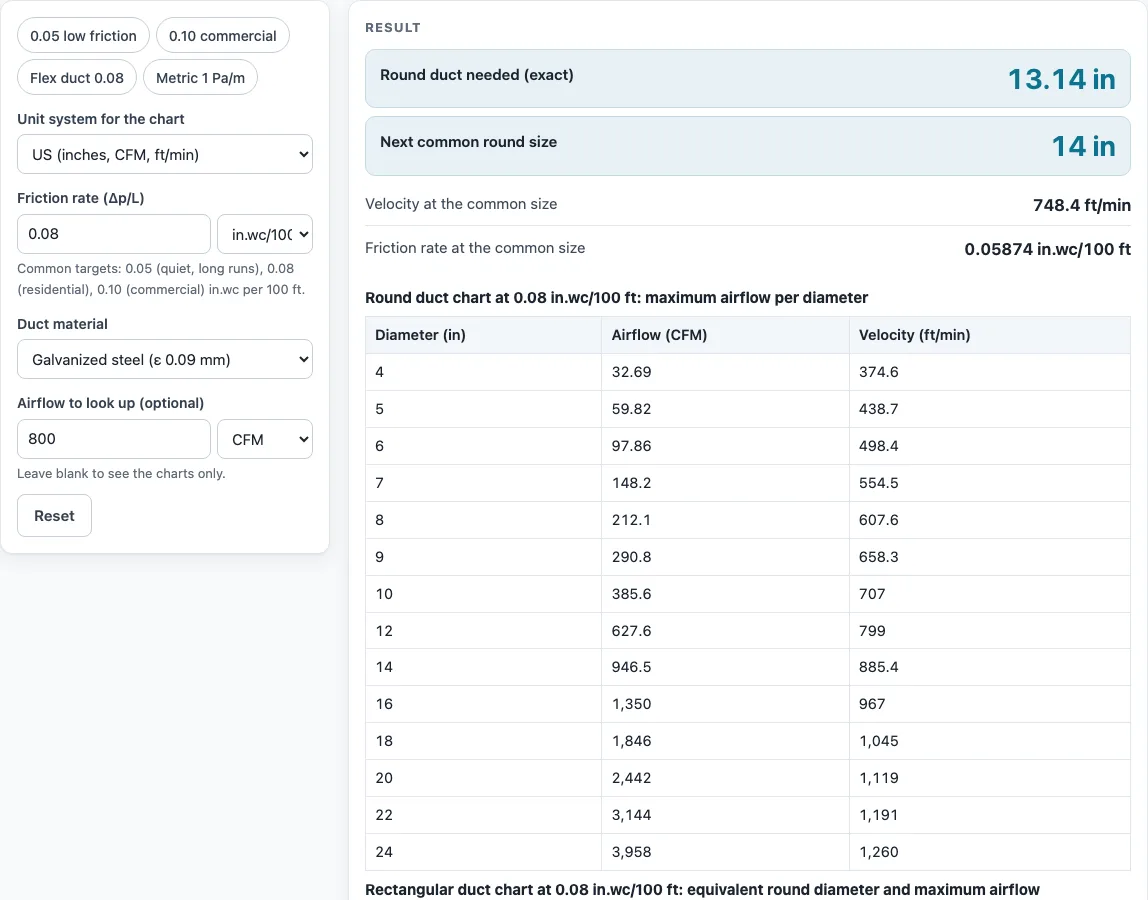
How to use the duct sizing chart
- Set Unit system for the chart to US (inches, CFM, ft/min) or Metric (mm, m³/h, m/s).
- Enter a Friction rate (Δp/L) in in.wc/100 ft or Pa/m. The starting value is 0.08; the example buttons also load 0.05 (low friction) and 0.10 (commercial).
- Choose a Duct material: galvanized steel, flexible duct (fully extended), or duct board / fibrous glass.
- Optionally, enter an Airflow to look up in CFM, m³/h, or L/s. Leave it blank to see the charts only.
- Read the result rows. They show Round duct needed (exact), Next common round size, Velocity at the common size, and Friction rate at the common size. Only the rows that match your mode appear.
- Check any warning shown above the result.
- Scroll down to the round duct chart and the rectangular duct chart.
- Open How it was calculated to see the formula and each step with your numbers.
The example buttons above the form load preset inputs: 0.05 low friction, 0.10 commercial, Flex duct 0.08, and Metric 1 Pa/m. Reset restores the starting example. Copy result copies the result lines and a link. Copy link stores every input in the page address, so the same calculation reopens later. Print / save as PDF includes your inputs, results, steps, and the date.
How do you read a duct sizing chart?
Find your friction rate first, because every value in the chart depends on it. Then move along that row or column to the duct size you are considering. The chart shows the maximum airflow that size can carry at that friction rate. If your required CFM is higher than the listed value, go up one size.
The round-duct table lists each diameter with its maximum airflow. The rectangular table lists each width and height with its equivalent round diameter, which is the round size that moves the same air at the same friction rate. Use the equivalent diameter to compare a rectangular duct with a round one. Printed ductwork sizing charts and HVAC ductwork sizing charts work the same way, but they are fixed to one friction rate and material; this ductwork CFM chart is recalculated for whatever you choose, including a flex ductwork CFM chart when you select flexible duct.
How many CFM can a 6 inch duct carry?
It depends on the friction rate and material. At 0.08 in.wc/100 ft, a 6 inch galvanized steel duct carries about 98 CFM at roughly 500 ft/min, while a 6 inch flexible duct, fully extended, carries about 84 CFM. Look up 6 inches in the round-duct chart at your own friction rate and material.
Higher friction rates let a smaller duct carry the same CFM, but they require more fan pressure and make more noise. Flexible duct carries less air than metal duct of the same size because it is rougher. The velocity at the chosen size also matters. Residential supply ducts are often kept below about 900 ft/min to limit noise. This is guidance, not a code limit.
Sources
Data and methods used by this calculator (checked October 2026):
- ASHRAE Handbook—Fundamentals 2017, ch. 21 Duct design (Table 1 roughness, Darcy–Weisbach, Huebscher)
- HVAC School, Under pressure (900 ft/min supply trunk guidance)
Worked examples
| Input | Result |
|---|---|
| 800 CFM at 0.08 in.wc/100 ft | 13.14 in exact, use 14 in |
| 400 CFM at 0.05 in.wc/100 ft | 11.16 in exact, use 12 in |
| 2000 CFM at 0.10 in.wc/100 ft | 17.73 in exact, use 18 in |
| 150 CFM at 0.08 in.wc/100 ft | 7.464 in exact, use 8 in |
| 500 m³/h at 1 Pa/m | 210.5 mm exact, use 250 mm |
Calculated by the tool above with these values.
Frequently asked questions
What size flex duct do I need for 100 CFM?
Enter 100 in Airflow to look up, select Flexible duct as the material, and set your friction rate. The result gives the round size needed and the next common size up. Flex duct must be kept fully stretched with gentle bends, or its friction can be much higher than the chart shows.
How many CFM does a 10 inch round duct carry?
At 0.08 in.wc/100 ft, a 10 inch galvanized steel duct carries about 386 CFM at about 707 ft/min; as fully extended flexible duct it carries about 328 CFM. Other friction rates give other values, so check the 10 inch row of the chart at your settings.
What does friction rate mean on this chart?
Friction rate is the pressure loss per length of duct, shown as in.wc per 100 ft or Pa/m. A lower value means quieter, lower-pressure airflow but larger ducts. A higher value means smaller ducts that need more fan pressure.
Why does the calculator show an equivalent round diameter for rectangular ducts?
A rectangular duct does not have one diameter, so the calculator converts it to the round diameter that carries the same air at the same friction rate. The conversion uses the Huebscher equation. This lets you compare rectangular and round options on equal terms.
Can I use these results in a client quote?
Yes. Results, charts, and printouts may be used freely in commercial work such as quotes, proposals, reports, and service records, with no attribution needed. The note under each result says it is for estimation, so verify critical designs against the applicable standard.
Related tools
- Duct size calculator: use it when you know the airflow and want a duct size for a specific design.
- CFM calculator: use it when you need to work out the airflow a space requires.
- AC size calculator: use it when you are estimating the cooling capacity of an air conditioner.
- BTU calculator: use it when you need a heating or cooling load estimate in BTU.
- Mini split BTU calculator: use it when you are sizing a ductless mini split system.
- All HVAC calculators: use it to browse every calculator on the site.