Duct Size Calculator
Enter the airflow and a friction rate or velocity limit to get the round duct size, its velocity and rectangular equivalents.
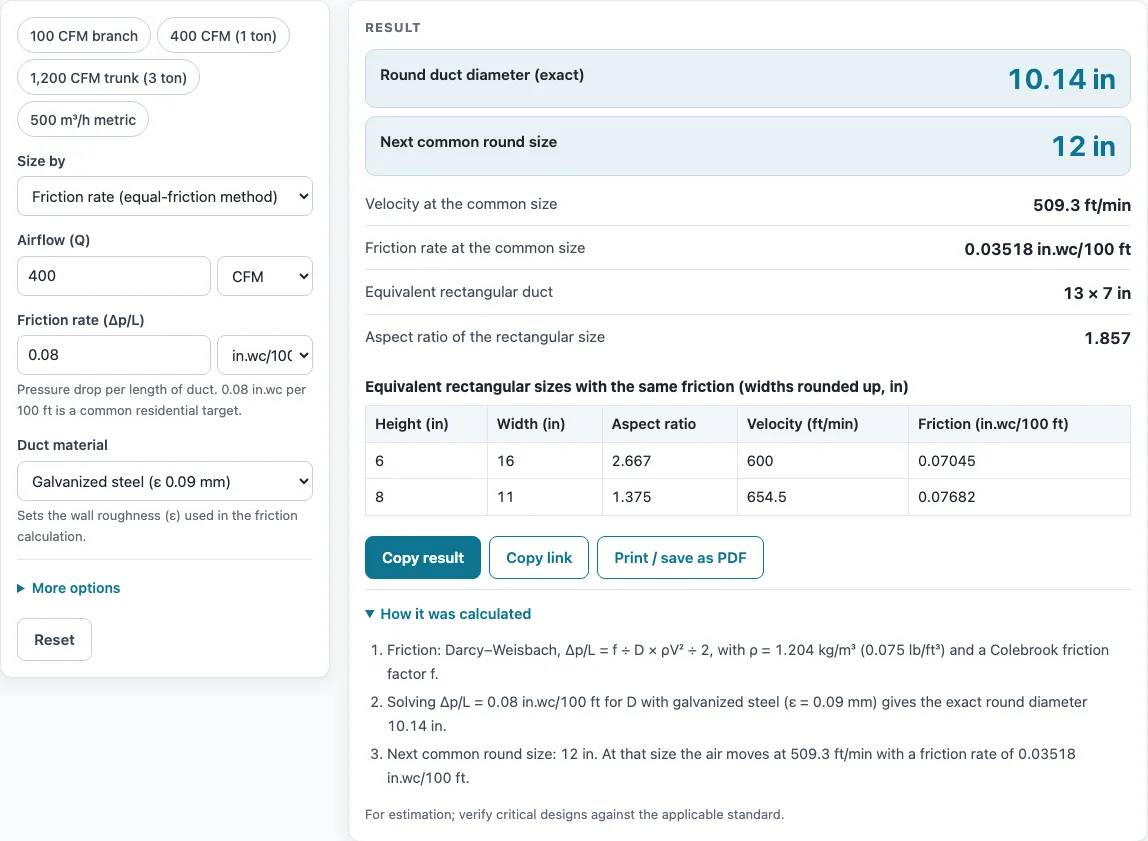
How to use the Duct Size Calculator
- Open Size by and choose a mode: Friction rate (equal-friction method), Maximum velocity, or Check an existing duct size.
- Enter the airflow in Airflow (Q) and pick its unit: CFM, m³/h or L/s.
- In friction rate mode, enter Friction rate (Δp/L) in in.wc/100 ft or Pa/m. 0.08 in.wc per 100 ft is the example value; ACCA Manual D derives the design friction rate from the blower’s available static pressure and the longest duct run.
- In maximum velocity mode, enter Maximum velocity (V) in ft/min or m/s.
- Choose Duct shape: Round or Rectangular. For a rectangular duct, open More options and set Rectangular size by to Aspect ratio or One fixed side, then fill in the matching field.
- Choose Duct material. Galvanized steel is the smooth default. If you pick flexible duct, keep it fully stretched.
- In Check an existing duct size mode, enter the diameter, or the width and height, of the duct you already have.
- Read the results and any warnings, then open How it was calculated to see every step with your numbers.
The example buttons above the form (100 CFM branch, 400 CFM (1 ton), 1,200 CFM trunk (3 ton), and 500 m³/h metric) fill in sample inputs. Copy link saves every input in the page address, so you can reopen the same calculation later. Print / save as PDF includes your inputs, results, steps and the date. Reset restores the starting example.
How do I determine duct size?
Ducts are usually sized with the equal-friction method. You choose a friction rate, which is the pressure loss per 100 feet of duct, and then find the diameter that carries your airflow at that rate. The calculator uses the Darcy–Weisbach equation with the Colebrook friction factor, the approach in the ASHRAE Fundamentals duct design method, for standard air at 0.075 lb/ft³.
Velocity is airflow divided by the cross-section area. Residential supply ducts are often kept below about 900 ft/min to limit noise. This is guidance, not a code limit, so check the velocity as well as the friction rate.
Duct material changes the result. Galvanized steel has a roughness of 0.09 mm. Fully extended flexible duct is rougher (0.9 mm, the “medium rough” class in ASHRAE’s duct roughness table), so the same airflow needs a larger flex duct. For a rectangular duct, the tool uses the Huebscher equation to find the round duct with the same friction: De = 1.30 (a·b)^0.625 / (a+b)^0.25. For example, 400 CFM in a 12 × 8 in rectangular duct gives 0.06272 in.wc/100 ft at 600 ft/min, and a 12 × 8 in duct equals about a 10.7 in round duct.
What friction rate should I use for duct sizing?
0.08 in.wc per 100 ft is the example value here; Manual D sets the design friction rate for each system from the available static pressure and the total effective duct length. A lower friction rate gives a larger duct that moves air more quietly and with less fan effort. A higher friction rate gives a smaller duct that costs less in material but makes the fan work harder and can be noisier.
If you already know the velocity you want, use the Maximum velocity mode instead. For example, 400 CFM at a maximum of 700 ft/min gives 10.24 in exact, so use a 12 in duct. In metric, 500 m³/h at 1 Pa/m gives 210.5 mm exact, so use 250 mm.
Sources
Data and methods used by this calculator (checked October 2026):
- ASHRAE Handbook—Fundamentals 2017, ch. 21 Duct design (Table 1 roughness, Darcy–Weisbach, Huebscher)
- HVAC School, Under pressure (900 ft/min supply trunk guidance)
Worked examples
| Input | Result |
|---|---|
| 400 CFM at 0.08 in.wc/100 ft | 10.14 in exact, use 12 in |
| 100 CFM at 0.08 in.wc/100 ft | 6.048 in exact, use 7 in |
| 1200 CFM at 0.08 in.wc/100 ft | 15.31 in exact, use 16 in |
| 400 CFM at 700 ft/min maximum | 10.24 in exact, use 12 in |
| 500 m³/h at 1 Pa/m | 210.5 mm exact, use 250 mm |
| 400 CFM in 12 × 8 in | 0.06272 in.wc/100 ft, 600 ft/min |
Calculated by the tool above with these values.
Frequently asked questions
What size duct for 400 CFM?
At 0.08 in.wc per 100 ft, 400 CFM needs an exact round diameter of 10.14 in, so the next common size is 12 in. A typical 1-ton system moves about 400 CFM, which is why this example is a common starting point.
How do you calculate ductwork size?
Calculating ductwork size starts with the airflow, then a friction rate or maximum velocity. The calculator finds the exact diameter that carries that airflow, then rounds up to the next common duct size. Check the velocity at that size, because a duct that is too small can be noisy.
How do I convert a round duct to rectangular?
Use the Huebscher equation: De = 1.30 (a·b)^0.625 / (a+b)^0.25, where a and b are the width and height of the rectangle. Enter a rectangular size in the calculator to see its equivalent round diameter. For example, a 12 × 8 in rectangle is about the same as a 10.7 in round duct. Aim for an aspect ratio of 4:1 or less, because tall, narrow rectangles cost more friction.
Do flexible ducts need to be larger?
Yes. Flexible duct is much rougher than galvanized steel, so the same airflow needs a larger size. When you pick it, the calculator warns that it must be kept fully stretched with gentle bends, because compressed or sagging flex has much more friction than a straight run.
Can I use the results in a quote or report?
Yes. Results, charts and printouts can be used freely in commercial work such as quotes, proposals, reports and service records, and no attribution is needed. The note under every result says the calculator is for estimation, so verify critical designs against the applicable standard.
Does the calculator send my data anywhere?
No. Everything runs in your browser, and nothing is uploaded. You do not need to sign up.
Related tools
- Duct sizing chart: Use it to compare duct sizes across airflows without entering each value.
- CFM calculator: Use it when you need the airflow before you size the duct.
- AC size calculator: Use it to estimate the cooling capacity that sets the airflow for your ducts.
- BTU calculator: Use it to estimate the heating or cooling load for a room or building.
- Psychrometric calculator: Use it to work out air properties such as temperature and humidity.
- Furnace size calculator: Use it to estimate the heating output a furnace needs.
- All HVAC calculators: Use it to browse every calculator on the site.