CFM Calculator (Cubic Feet per Minute)
Pick what you know — room air changes, heat load, tons, duct velocity or a bathroom — and get the airflow in CFM, m³/h and L/s.
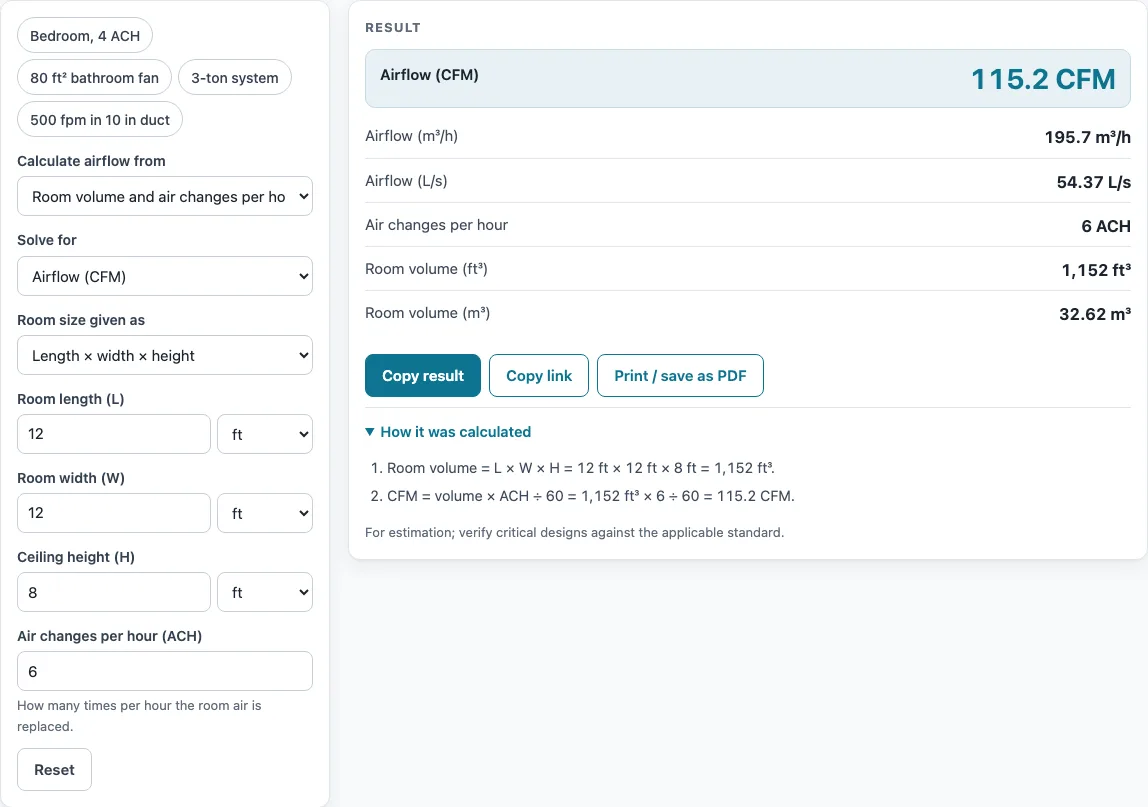
How to use the CFM calculator
- Open Calculate airflow from and choose the mode that matches your data: Room volume and air changes per hour, Sensible load and temperature difference, Cooling tons, Duct velocity and size, or Bathroom exhaust fan (HVI guidance).
- For a room, set Room size given as to Length × width × height or Floor area × height, enter the dimensions with their units, then Air changes per hour (ACH).
- For a heat load, enter Sensible load (q) with its unit, then Supply-to-room temperature difference (ΔT) in °F or °C.
- For cooling tons, enter Cooling capacity and Airflow per ton. Leave 400 CFM/ton if you have no design value.
- For a duct, enter Air velocity (V), set Duct shape to Round or Rectangular, and enter the diameter or the width and height.
- For a bathroom, enter the count in Toilets, showers and tubs and, if there is one, Jetted tubs.
- To work backwards, set Solve for to The other value, then enter Known airflow (Q) in CFM, m³/h or L/s. This option appears only in some modes.
- Read the results, the “How it was calculated” steps and any warnings.
Click one of the example buttons (Bedroom, 4 ACH, 80 ft² bathroom fan, 3-ton system, 500 fpm in 10 in duct) to load a worked case. Copy result copies the result lines and a link. Copy link stores every input in the page address, so the same calculation reopens later. Print / save as PDF produces the inputs, results, steps and date. Reset restores the starting example.
How do you calculate CFM?
CFM is the volume of air moved each minute, measured in cubic feet. It comes from one of three relationships: room volume times air changes per hour, a heat load divided by the temperature difference, or duct velocity times duct area.
For a room, CFM = volume (ft³) × air changes per hour ÷ 60. For a heat load, CFM = sensible BTU/h ÷ (1.08 × ΔT °F). The 1.08 is 0.075 lb/ft³ × 60 min/h × 0.24 BTU/lb·°F, the density and specific heat of standard air. For a duct, CFM = velocity (ft/min) × cross-section area (ft²). A 10 in round duct has an area of about 0.545 ft², so air moving at 500 ft/min carries about 272.7 CFM.
How many CFM do I need for a room?
Multiply the room volume by the air changes per hour you want, then divide by 60. A room of 1,344 ft³ at 4 air changes per hour needs 89.6 CFM. Turned around, 200 CFM through a 1,152 ft³ room gives 10.42 air changes per hour.
For a heat load, 24,000 BTU/h at a 20 °F difference needs 1,111 CFM. For a cooling system, the common nominal design value is about 400 CFM per ton, so a 3-ton system needs about 1,200 CFM.
Bathroom fans follow a different rule. HVI guidance gives 1 CFM per square foot of floor for bathrooms up to 100 ft², with a minimum of 50 CFM. An 80 ft² bathroom therefore needs 80 CFM. Larger bathrooms add 50 CFM for each toilet, shower or tub, and 100 CFM for a jetted tub.
Which method to use depends on the job. Ventilation and fume or odour control usually start from an air change rate, so the tool doubles as an air change rate calculator. Supply air for heating and cooling starts from the sensible load or the tons of cooling, which makes it an HVAC CFM calculator. Checking an existing duct starts from a measured velocity.
Sources
Data and methods used by this calculator (checked October 2026):
- ASHRAE Handbook—Fundamentals 2017, ch. 1 Psychrometrics
- ACHR News, rules of thumb: 400 cfm per ton of cooling
- Broan-NuTone, sizing a bathroom exhaust fan (HVI guidance)
- HVAC School, Under pressure (900 ft/min supply trunk guidance)
Worked examples
| Input | Result |
|---|---|
| Room with 4 air changes per hour | 89.6 CFM (152.2 m³/h) |
| 24000 BTU/h at ΔT 20 °F | 1,111 CFM (1,888 m³/h) |
| 3 ton at 400 CFM/ton | 1,200 CFM (2,039 m³/h) |
| 500 ft/min in 10 in round | 272.7 CFM (463.3 m³/h) |
| Bathroom of 80 ft² | 80 CFM (135.9 m³/h) |
| 200 CFM through a room of 1,152 ft³ | 10.42 air changes per hour |
Calculated by the tool above with these values.
Frequently asked questions
How do I calculate air changes per hour?
Divide the airflow in CFM by the room volume in ft³, then multiply by 60. The result is ACH = CFM × 60 ÷ volume. For example, 200 CFM in a 1,152 ft³ room gives 10.42 air changes per hour.
What size bathroom fan do I need?
Start with the floor area. Up to 100 ft², use 1 CFM per square foot with a minimum of 50 CFM. Above 100 ft², add 50 CFM for each toilet, shower or tub, and 100 CFM for a jetted tub. Check the fan label to confirm the rating.
How many CFM per ton?
The common nominal design value for cooling coils is 400 CFM per ton. A 3-ton system at this value needs 1,200 CFM. Your equipment’s own airflow specification takes priority over this figure.
What is the difference between CFM and m³/h?
Both measure airflow. CFM is cubic feet per minute, and 1 CFM equals 1.699 m³/h or 0.472 L/s. The calculator shows all three units in the results, so you can use whichever your documents require.
Why does the calculator warn about duct velocity above 900 ft/min?
Residential supply ducts are often kept below about 900 ft/min to limit noise. This is guidance, not a code limit. A warning tells you to check the design, but it does not mean the duct is wrong.
Can I use these results in a quote or permit?
Results can be used in quotes, proposals, reports and service records, with no attribution needed. The calculator is for estimation, so verify critical designs against the applicable standard.
Related tools
- Duct size calculator: use it to find a duct size when you know the airflow you need.
- Duct sizing chart: use it to look up duct sizes for common airflow values at a glance.
- AC size calculator: use it to estimate the cooling capacity a space needs before you choose airflow per ton.
- BTU calculator: use it to estimate the heat load in BTU/h that feeds the sensible load mode.
- Psychrometric calculator: use it to work out air properties such as moisture content and enthalpy.
- Dew point calculator: use it to check whether moisture will condense on cool surfaces.
- All HVAC calculators: use it to browse every calculator on the site.