Boiler Size Calculator
Size a boiler for space heating, a combi boiler for hot-water flow, or a system boiler for cylinder reheat.
The boiler size calculator works out the output, in kW or BTU/h, that a boiler needs to heat a building and its hot water. It covers combi, space-heating-only and system boilers, and it shows the boiler input once efficiency is included. Because every result is also given in BTU/h, it works as a boiler BTU calculator too.
The tool runs in your browser. It is free, needs no sign-up, and uploads nothing. Use it to check a figure before a quote, compare sizes, or see how changing insulation or hot-water flow changes the answer. Results are estimates, so verify critical designs against the applicable standard.
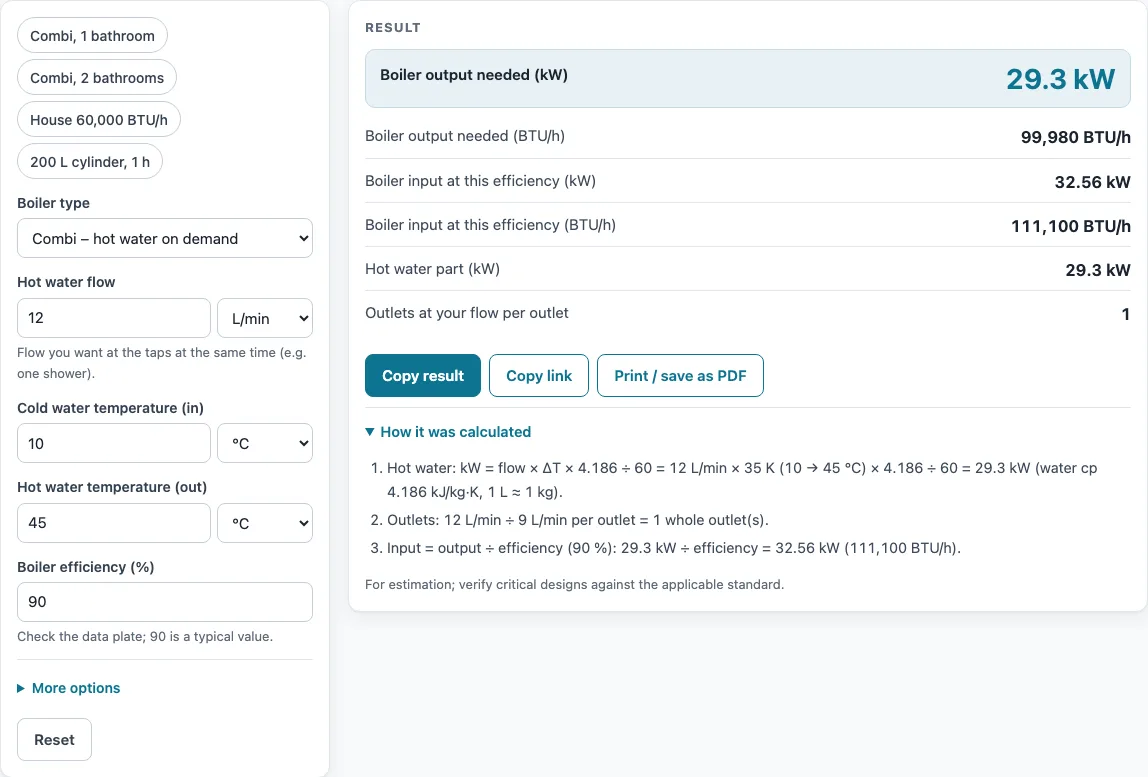
How to use the Boiler size calculator
- Choose a Boiler type: Combi (hot water on demand), Space heating only, or System boiler (heating plus cylinder). The fields below change to match your choice.
- For space heating, set Heating load: pick “I know the heat loss” and enter it in BTU/h, kW or W, or pick “Estimate it from the building” and fill in the floor area, stories, ceiling height, window share and insulation level.
- Enter the Indoor temperature and the Outdoor design temperature. Use your local winter design temperature.
- For a combi, enter the Hot water flow you need at the taps at the same time, plus Cold water temperature (in) and Hot water temperature (out). For a system boiler, enter the Cylinder volume and Reheat time.
- Enter Boiler efficiency (%) from the data plate (the starting value is 90).
- Open More options to set the flow per outlet, so the tool counts how many outlets run at once. You can also enter R-values, window U-factor and air changes per hour when the insulation level is Custom.
- Read the results, then check the “How it was calculated” section for each step with your numbers.
The example buttons above the form load Combi (1 bathroom), Combi (2 bathrooms), House 60,000 BTU/h, and 200 L cylinder in 1 h. Reset returns to the starting example. Copy result copies the result lines with a link, Copy link stores every input so the calculation reopens later, and Print / save as PDF includes inputs, results, steps and the date.
What size boiler do I need?
A boiler for space heating is sized to the building’s design heat loss, which is the heat the building loses on the coldest day you design for. The boiler input is the output divided by the efficiency, so a boiler delivering the output needed must draw more energy than it supplies.
For example, a 60,000 BTU/h heat loss (17.58 kW) at 90 % efficiency needs about 19.53 kW of input (17.58 ÷ 0.90).
What size combi boiler do I need?
A combi boiler is sized for hot-water flow rate, because it heats water on demand rather than from a cylinder. The output needed depends on how many litres per minute you want at the taps at the same time and how far the water must be heated.
For example, 12 L/min heated from 10 °C to 45 °C needs 29.3 kW (99,980 BTU/h). At 16 L/min the same temperature rise needs 39.07 kW (133,300 BTU/h). Where heating is included, the results show the space heating part and the hot water part separately.
How many kW boiler for a 3 bedroom house?
No single kW figure fits every 3-bedroom house, because the number of bedrooms is not an input. The calculator works from heated floor area, number of stories, ceiling height, windows, insulation and temperatures, so two houses with three bedrooms can need very different outputs.
As an example, a house of 2,000 ft² built to the IECC 2018 climate zone 5 preset with an estimated heat loss needs 6.077 kW (20,740 BTU/h). This is not a 3-bedroom benchmark. Enter your own floor area and insulation level to get a figure for your home.
How is a combi boiler’s hot water flow rate calculated?
The heat needed for hot water is kW = flow (L/min) × temperature rise (K) × 4.186 ÷ 60. The number 4.186 is the heat needed to raise 1 kg of water by 1 K in kJ, and dividing by 60 converts the per-minute flow to per second. Turning the formula around, the flow a boiler can deliver is kW × 60 ÷ (temperature rise × 4.186).
For example, 10 L/min heated by 35 K needs about 24.4 kW. Cold incoming water is colder in winter, which raises the temperature rise and lowers the flow a combi can deliver, so size for winter conditions.
Sources
Data and methods used by this calculator (checked October 2026):
- IECC 2018 prescriptive insulation and fenestration values (climate zone 5), state summary
- NIST Special Publication 811, unit conversion factors (BTU, ton, horsepower, therm)
Worked examples
| Input | Result |
|---|---|
| Combi, 12 L/min, water 10 °C → 45 °C | 29.3 kW (99,980 BTU/h) |
| Combi, 16 L/min, water 10 °C → 45 °C | 39.07 kW (133,300 BTU/h) |
| Combi, 3 gpm, water 50 °F → 120 °F | 30.81 kW (105,100 BTU/h) |
| Space heating, heat loss 60000 BTU/h | 17.58 kW (60,000 BTU/h) |
| House of 2000 ft², estimated heat loss | 6.077 kW (20,740 BTU/h) |
| System boiler, 200 L cylinder in 1 h | 25.72 kW (87,770 BTU/h) |
Calculated by the tool above with these values.
Frequently asked questions
Is the boiler size calculator free to use?
Yes. It is free, needs no sign-up, and runs entirely in your browser. Nothing you enter is uploaded.
Can I use the results in a quote or report?
Yes. Results, including numbers, charts and printouts, may be used freely in commercial work such as quotes, proposals, reports and service records. No attribution is needed.
What does boiler input mean?
Boiler input is the energy the boiler draws, and it equals the output divided by the efficiency. Check the efficiency on the boiler’s data plate.
How do I size a system boiler with a cylinder?
Choose System boiler, then enter the space heating load and the cylinder volume and reheat time. The cylinder adds kW = volume × 4.186 × temperature rise ÷ (time in seconds). The “200 L cylinder, 1 h” example heats 200 L by 35 K in an hour, which adds 8.14 kW to a 17.58 kW heating load, for 25.72 kW of output (28.58 kW input at 90 %).
Why does the calculator show a warning?
It warns when the outdoor design temperature is not below the indoor temperature, which sets the space heating load to 0. It also warns when efficiency is below 60 % or the hot-water flow is very large for one dwelling, so check those values.
Should I rely on the result for a final design?
Treat the result as an estimate. For critical designs, verify it against the applicable standard.
Related tools
- Furnace size calculator: use it when you are sizing a furnace rather than a boiler.
- Radiator BTU calculator: use it to check how much heat each radiator must deliver.
- BTU calculator: use it for general heat-load and BTU questions.
- BTU to kW converter: use it to convert between BTU/h and kW quickly.
- All HVAC calculators: browse every calculator on the site.