BTU Calculator for Cooling and Heating
Enter the room size and conditions to get the BTU/h you need for an air conditioner or a heater, with every step shown.
Popular tools
- R22 PT Chart (R-22 Pressure Temperature)Look up the R-22 saturation pressure for a temperature, or the temperature for a gauge reading, and print the full chart.
- Refrigerant PT Chart (Pressure Temperature)Choose a refrigerant to see its pressure temperature chart, or convert a gauge pressure to saturation temperature.
- R404A PT Chart (R-404A Pressure Temperature)Look up the R-404A saturation pressure for a temperature, or the temperature for a gauge reading, and print the full chart.
How to use the BTU calculator
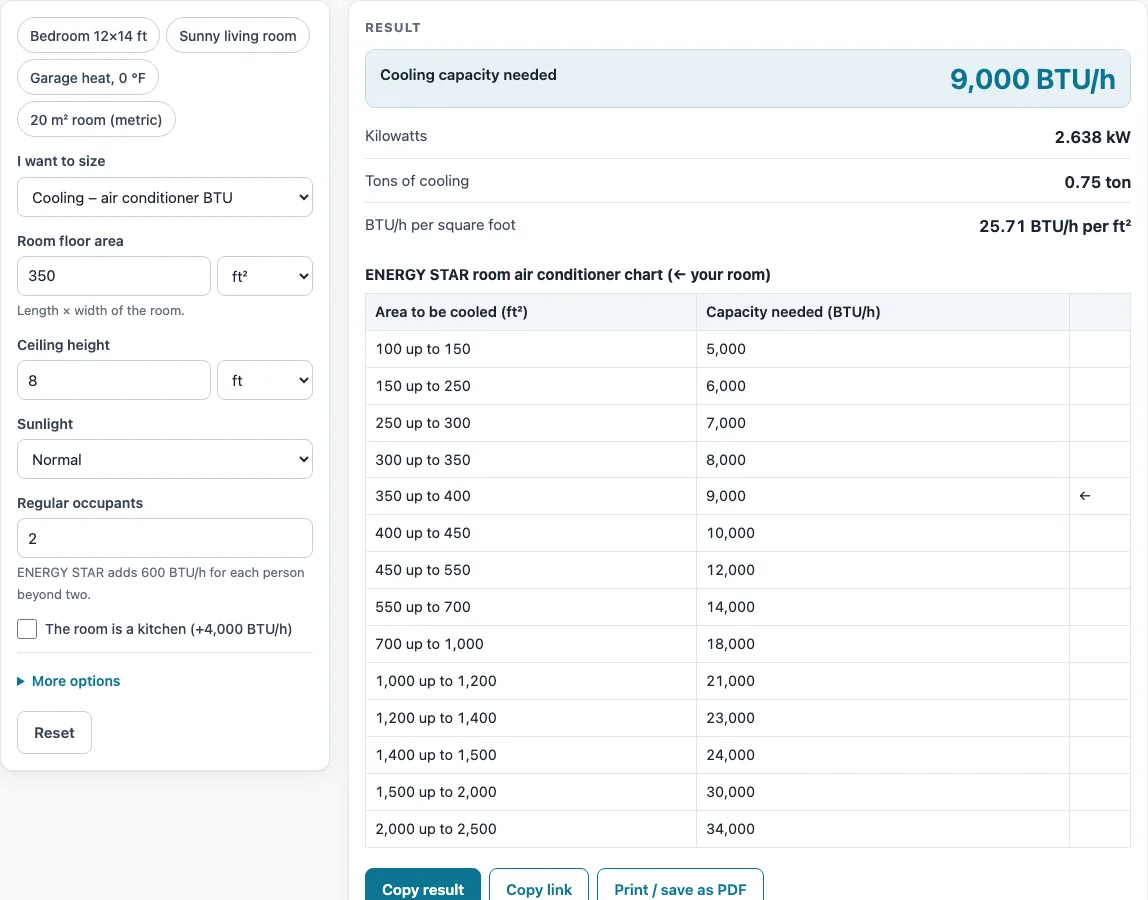
- Open “I want to size” and choose Cooling – air conditioner BTU or Heating – room heat loss.
- Enter the “Room floor area” in ft² or m². Measure the room’s length and width and multiply them.
- Enter the “Ceiling height” in ft or m.
- In cooling mode, set “Sunlight” to Heavily shaded, Normal or Very sunny. Enter “Regular occupants”, and tick “The room is a kitchen” if it applies.
- In heating mode, enter “Exterior wall length”, “Window area”, “Insulation level”, “Indoor temperature” and “Outdoor design temperature”.
- Open “More options” to enter wall, ceiling and floor R-values, the window U-factor and air changes per hour. Choose Custom in “Insulation level” first if you want to type your own R-values.
- Read the result rows and any warning, then check “How it was calculated” to see each step with your numbers. In cooling mode a table also marks your room’s band in the ENERGY STAR chart; in heating mode a table shows where the heat goes.
The example buttons above the form (Bedroom 12×14 ft, Sunny living room, Garage heat, 0 °F and 20 m² room) fill the form with a starting case you can edit. Use Copy result or Print / save as PDF to keep a record, Copy link to reopen the same inputs later, or Reset to return to the starting example.
How many BTU do I need per square foot?
There is no single BTU per square foot figure that fits every room, whether you write it as BTU per sq ft, BTU per sq foot, BTU per sq feet or BTU per SF. For cooling, the ENERGY STAR room air conditioner chart works out to about 20–50 BTU/h per ft² for small rooms and about 14–17 per ft² for large open areas.
The rate drops as the room grows because the chart uses size bands rather than a straight line, so the BTU for a given square footage is read from its band, not multiplied out. A 168 ft² room with two regular occupants needs 6,000 BTU/h, about 36 BTU/h per ft², while a 500 ft² room with four people and strong sun needs 14,400 BTU/h, about 29 per ft².
How do you calculate BTU for a room?
For cooling, start with the ENERGY STAR band that matches your floor area, then adjust it. Subtract 10 % for a heavily shaded room, add 10 % for a very sunny room, add 600 BTU/h for each regular occupant beyond two, and add 4,000 BTU/h if the room is a kitchen.
Take a very sunny 500 ft² room with four regular occupants. The 450–550 ft² band gives 12,000 BTU/h. Sun adds 10 % (1,200 BTU/h), and the two extra people add 1,200 BTU/h, for a total of 14,400 BTU/h.
Figuring BTU for heating works differently. It adds up the heat that leaves the room through each wall, window, ceiling and floor, using U-value × area × temperature difference for each part. Air leakage is added on top, based on the room’s air changes per hour. The temperature difference is the indoor temperature minus the outdoor design temperature.
How many BTU to heat a garage?
Estimate a garage with Heating mode, not a fixed BTU per square foot. Garages often have little insulation and large openings, so enter your garage’s own R-values under Custom, and try the Garage heat example first (it uses the IECC 2018 code preset).
A 576 ft² space with 55 °F inside, 0 °F outside built to the IECC 2018 climate zone 5 preset gives 5,457 BTU/h (1.6 kW) in this calculator; a leaky, uninsulated garage will lose far more, so use Custom for real values. Change the wall length, window area, insulation and temperatures to match your garage, since each one changes the heat loss.
Is a bigger air conditioner better?
No. A unit much larger than the cooling load reaches the set temperature quickly, switches off before it has removed much humidity, and can leave the room feeling clammy. A unit that is too small runs almost constantly and may not keep up on the hottest days.
Aim for the BTU/h the calculator gives for your room. Move to the next size up only when the result sits between two standard sizes and the room has a clear reason for extra capacity, such as strong sun.
How many BTU is a ton?
One ton of cooling equals 12,000 BTU/h, which is 3.517 kW. Cooling equipment is often described in tons, so a 24,000 BTU/h air conditioner is a two-ton unit.
The results list tons of cooling alongside BTU/h and kilowatts, so you can compare them with labels in any of those units. One kilowatt is about 3,412 BTU/h.
Sources
Data and methods used by this calculator (checked October 2026):
- ENERGY STAR, room air conditioner sizing chart and adjustments
- ASHRAE Handbook—Fundamentals 2017, ch. 1 Psychrometrics
- IECC 2018 prescriptive insulation and fenestration values (climate zone 5), state summary
- NIST Special Publication 811, unit conversion factors (BTU, ton, horsepower, therm)
Worked examples
| Input | Result |
|---|---|
| 350 ft², Normal, 2 people | 9,000 BTU/h (2.64 kW) |
| 168 ft², Normal, 2 people | 6,000 BTU/h (1.76 kW) |
| 500 ft², Very sunny (+10 %), 4 people | 14,400 BTU/h (4.22 kW) |
| Heating 576 ft², 55 °F inside, 0 °F outside, insulation: IECC 2018 code level, zone 5: wall R-20, ceiling R-49, floor R-30, windows U-0.30 (0.3 ACH assumed) | 5,457 BTU/h (1.6 kW) |
| 20 m², Normal, 2 people | 6,152 BTU/h (1.8 kW) |
Calculated by the tool above with these values.
Frequently asked questions
Is the result an exact number?
No. It is an estimate for a single room, and critical designs should be verified against the applicable standard. For a whole house, a room-by-room load calculation such as ACCA Manual J is the proper method.
Which outdoor temperature should I enter?
Use your local winter design temperature, the cold temperature exceeded 99 % of the year, rather than the record low. The record low is colder than the design condition for most winters, so using it makes the heat loss larger than you usually need.
Why does my heat loss show 0?
The outdoor temperature is not below the indoor temperature, so no heating is needed. Check both temperatures and their units if you expected a heating load.
Can I use metric units?
Yes. Floor area can be entered in m², ceiling height in m, and temperatures in °C. The 20 m² example, with normal sunlight and two people, gives 6,152 BTU/h (1.8 kW).
What does the small-room warning mean?
Rooms under 100 ft² are smaller than the ENERGY STAR chart’s first band. The calculator then shows the smallest size, 5,000 BTU/h, so treat that value as a minimum rather than a precise figure.
Can I use the results in a quote or report?
Yes. Results, charts and printouts can be used freely in commercial work such as quotes, proposals, reports and service records. No attribution is needed.
Related tools
- AC size calculator: use it when you are choosing an air conditioner for a room or zone and want a sizing check.
- Mini split BTU calculator: use it when you are sizing a ductless mini split system.
- Furnace size calculator: use it when you need a heating output for a furnace serving a home.
- Radiator BTU calculator: use it when you are checking whether a radiator can output enough heat for a room.
- BTU to kW converter: use it when you need to convert between BTU/h and kilowatts quickly.
- CFM calculator: use it when you are working out airflow for a ventilation or HVAC system.
- Boiler size calculator: use it when you are estimating the output a boiler needs for a building.
- All HVAC calculators: use it when you want to browse every calculator on the site.